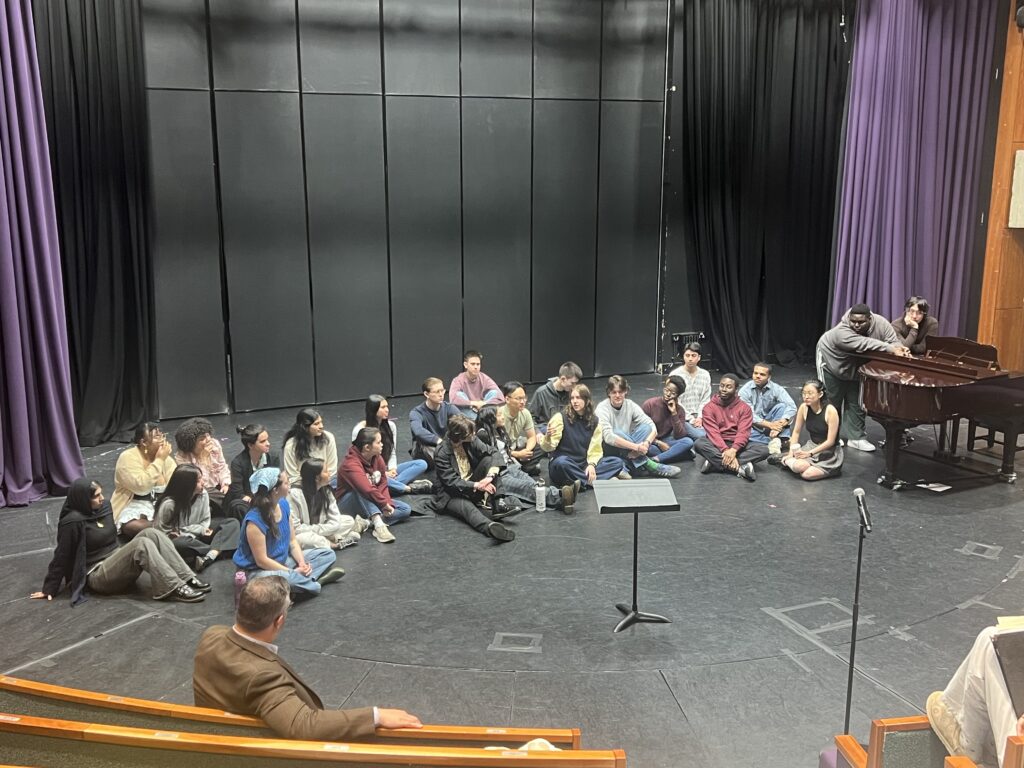
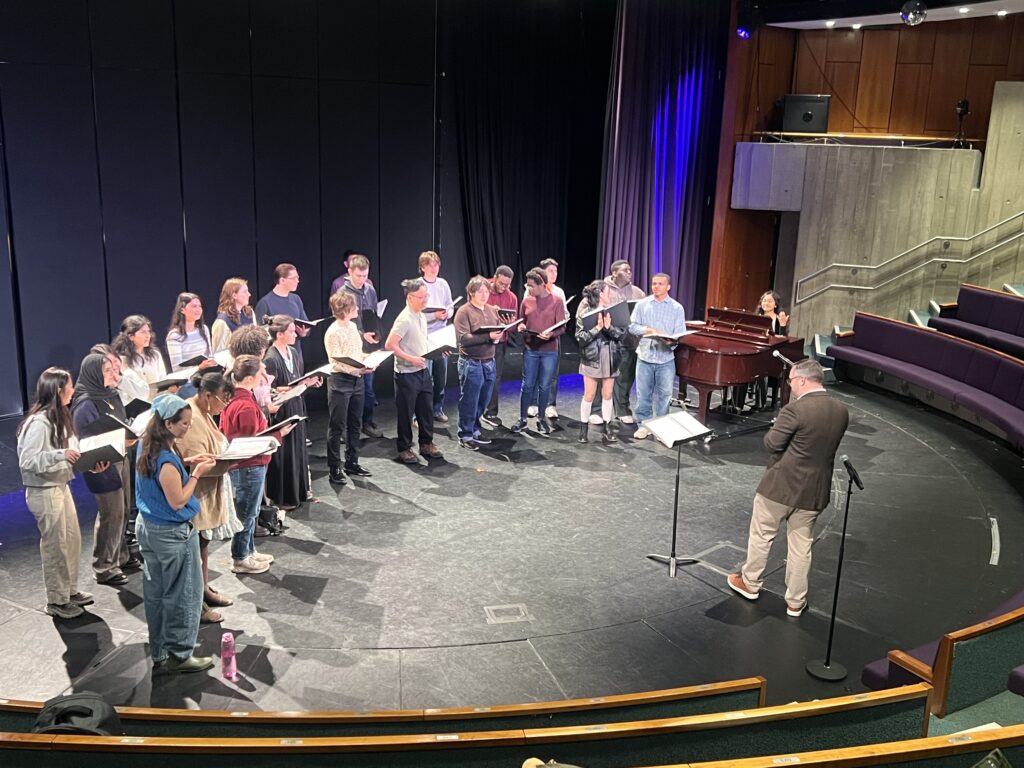
Back on campus, Garnet Singers had two more quick things to do before the official conclusion of the trip. We returned during the busy rush of Commencement Weekend. Normally, many members of Garnet Singers have already dispersed for the year, heading off to all corners of the world to start their summer plans. That the group was all back on campus at a time when seniors and their families and friends were celebrating meant we could be part of the special weekend as well.
Garnet Singers joined graduating seniors and others from the College choirs to sing some traditional Swarthmore songs at the Baccalaureate service. We also held an informal, end-of-the-trip concert in Lang Concert Hall. This was a great opportunity to bring the experience we had in the U.K. back to campus, to perform for audience members who may not be on campus during our regular end-of-semester concerts, and, most importantly, to have one final opportunity to sing with graduating seniors before they moved on from Swarthmore. It was a bittersweet moment but a lovely one as well, and we left the experience—and the trip overall—with a deep sense of gratitude for this unique and wonderful opportunity!
After an incredibly busy week, numerous concerts, services, workshops, and other ways of engaging and connecting with fellow choirs and one another, and plenty of incredible sights to see, Garnet Singers began the long journey back to the States early on May 22. Our return trip gave an opportunity to reflect on the experiences of the trip. Hannah describes the experience below:
In addition to exploring my singing capabilities, this trip allowed me to explore parts of the world that I have never been to. I thought that the trip was a nice mix of musical performances, workshops, and concerts, as well as relaxation time to make sure that we could get some rest between performances. I had been to London twice before, but being able to wander around the city independently was a much needed experience. At the start of the trip, my agenda did not include speedwalking across almost the entirety of Hyde Park, but I’m so glad that I was able to do it. London has so much history, nature, and busy life all clustered together. As someone who loves to sight see, I was so happy to be able to see Big Ben, Westminster Abbey, Buckingham Palace, Hyde Park, and the Paddington gift shop all in one day! My true greatest find in England was the M&S grocery store that I went to at least 5 or 6 times.
I was also very excited to go to Cambridge since I had never been there before. I had such a fun time walking around, shopping, and going punting. The university has such a great amount of history that it makes Swarthmore feel like such a new college. Walking around Cambridge was one of my favorite pastimes. I originally felt that the walk from our hotel to the university was far – especially when Chung Sze and I half-ran the walk in order to race the group that took the bus – but it ended up becoming a great pleasure of mine. The walk to Cambridge was filled with lots of different shops and restaurants as well as some beautiful buildings, so I’m pretty glad that things ended up the way that they did.
I also really loved the unique characteristics that the U.K. has. One big difference from the U.S. is that they drive on the left side of the road. I also really enjoyed seeing their small cars. For some of them, it seemed nearly impossible for someone to get in the backseat, but the cars were very adorable. Another thing that I liked was that everyone had slightly different accents. To me, they sounded pretty similar, but when talking to someone from the Reading Bach Choir, they told me that they could distinguish the region that someone was from just by their accent. Another thing that I found to be very intriguing was how connected everybody was, at least in the musical realm. One of the women from The Bach Choir approached us to say that her husband was in the Reading Bach Choir and not only that, that she actually attended the ORA Singers concert and saw us there as well!
Another really great part of this trip was that I was able to connect with so many members of Garnet Singers that I hadn’t really talked to before, as well as the chaperones. Our group dinners and outings allowed me to find natural ways to get to know the members of our choir that I wasn’t able to do during rehearsal or outside rehearsal. This trip was a great bonding experience for us all and I hope that it may allow us to connect in our singing too. Everyone on this trip really looked out for each other.
I feel like this trip allowed me to have a glimpse into what it would be like to study abroad. I’ve spent almost all of my life in Pennsylvania, and I chose not to study abroad due to a fear of living so far from home. However, on this trip I feel like I’ve been able to take leadership and understand more about my own limits. I’m glad that we had a lot of free time on our trip because it gave me a chance to explore my independence.
On the way home! (photo by Pat) [Garnet Singers on a bus on the way home to the U.S.]
Ely Cathedral (photo by Nathan) [The exterior of a portion of Ely Cathedral, with two large towers in view and the Lady Chapel to the side in the background]
Familiar faces! (photo by Colette) [Students gathered in an alcove outside of Ely Cathedral, looking at a large monitor advertising the lunchtime recital series with a photo of Garnet Singers performing at Swarthmore]
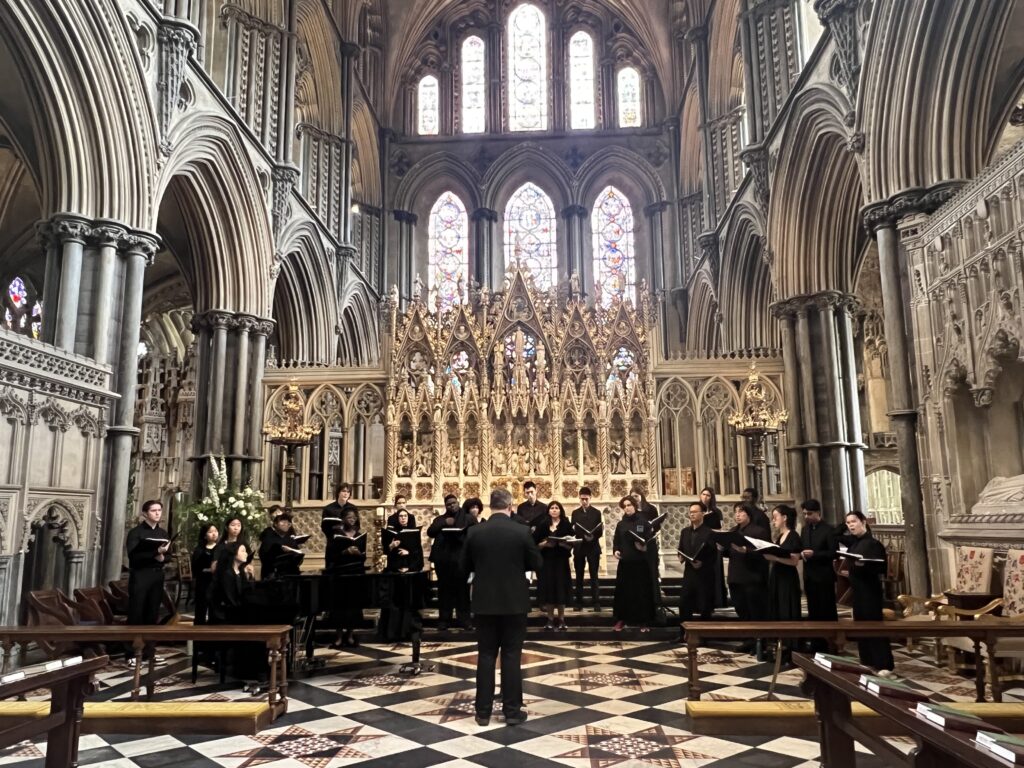
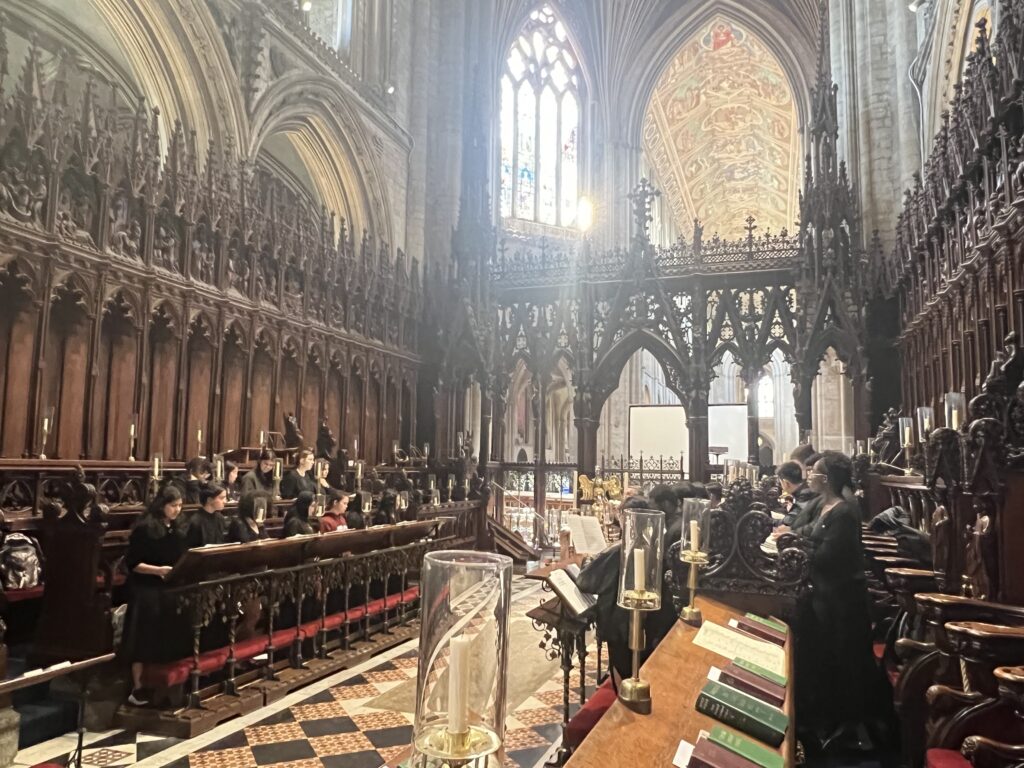
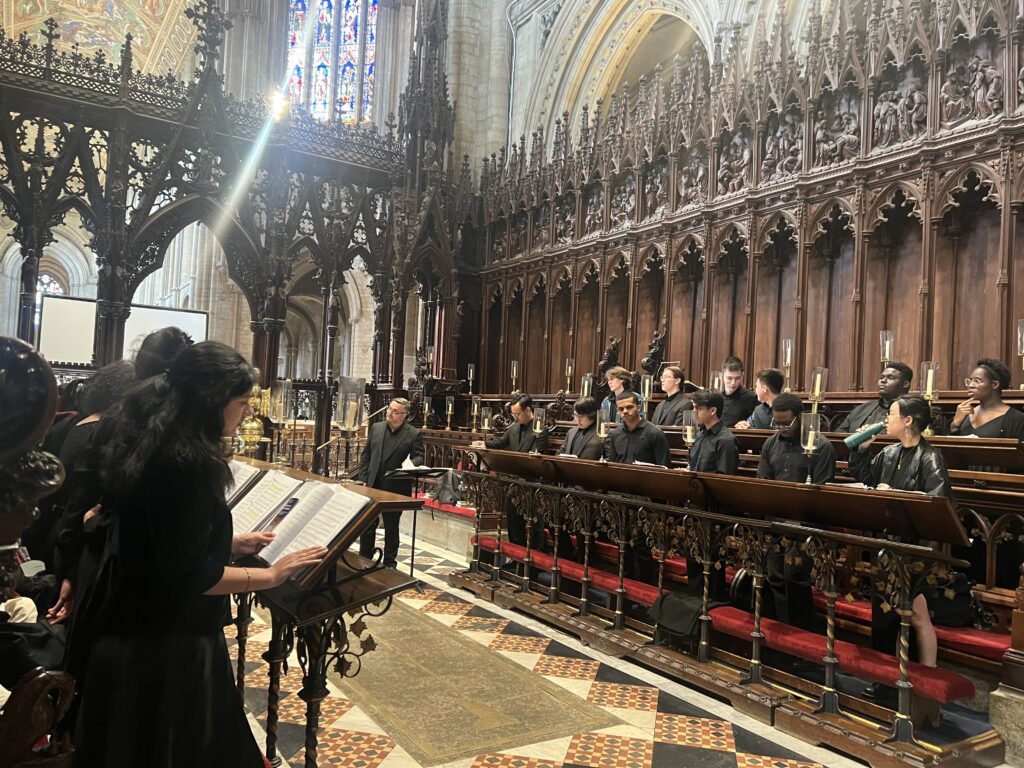
On Thursday, May 21, Garnet Singers returned to Ely Cathedral for a second time, although in this case to sing as part of the lunchtime recital series. This meant that the group had the opportunity to give an hour-long performance of the music we have prepared and performed throughout the year. As our last performance in the U.K., it was also a chance to share what we do with British audiences one more time before heading back to the States.
Garnet Singers perform at the Cathedral’s lunchtime recital series (photo by Hsiao-Han) [Garnet Singers in two rows, dressed in concert black attire and holding folders, singing in front of a large, intricate backdrop and stained glass windows]
Afterwards, we returned for a final afternoon and evening in Cambridge. The group visited Jesus College once again to attend (as listeners this time, rather than singers!) Evensong and, many singers enjoyed one more time taking in the sights (and maybe getting one last gelato). We finished the night with a group bowling excursion and got ready to bid farewell to the U.K. early the next morning.
Saying goodbye to Ely Cathedral (L) and a final view of the streets of Cambridge (R) (photos by Ryan and Silja) [Garnet Singers walking away down a narrow street outside of Ely Cathedral with a high wall and buildings on the side; a pedestrian street in Cambridge lined with buildings and colorful flags hanging from above]
A graduating senior member of the group reflects on the final concert at Ely Cathedral and the end of the tour:
On May 21st we had our last full run of repertoire at the Ely Cathedral for a lunchtime public concert. It was a very bittersweet moment for me as I was incredibly happy to sing all these amazing songs again but it would be for the last time ever as part of Garnet Singers. By this time in the trip, I think all of our voices were definitely not in the same condition as when we started but we finished strong.
The area surrounding Ely Cathedral is just as beautiful as the cathedral itself. It felt like I was walking onto a medieval movie set with rolling hills of green pasture and Ely Cathedral in the distance. Our tour guide from the previous day provided little tidbits about how Ely Cathedral was constructed and the meanings behind each stained glass and the ceilings that depict an entire story. It felt even more special having the opportunity to perform pieces such as Peace I Leave With You and Cells Planets knowing the history and facts about Ely.
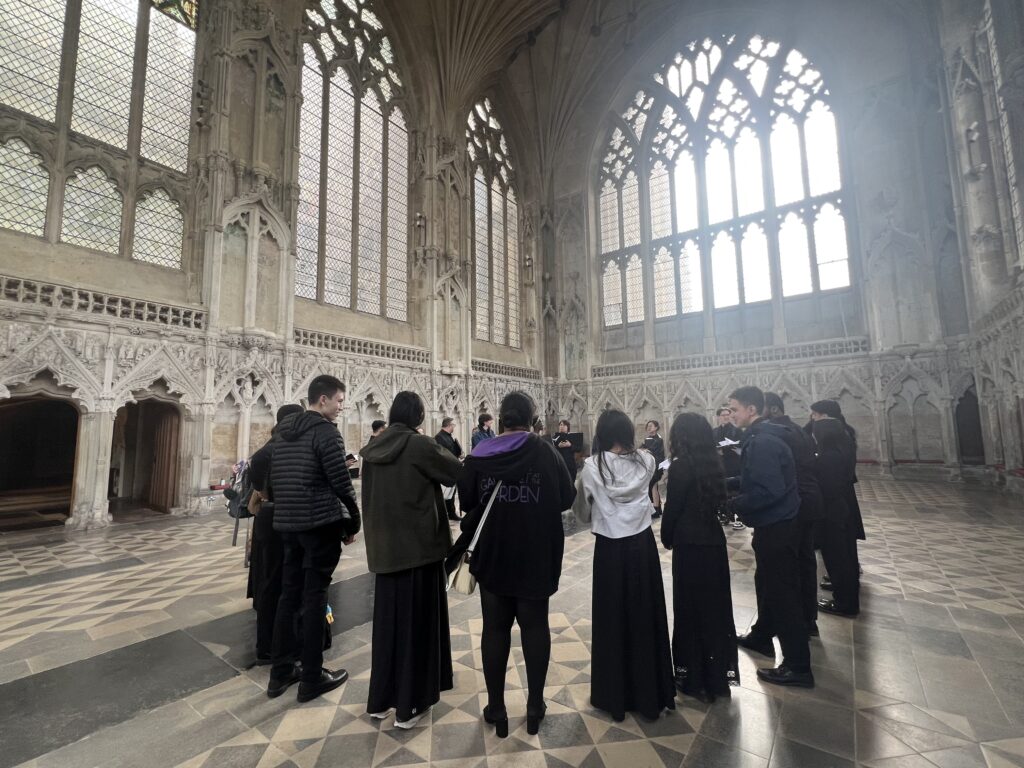
By far though my favorite area in Ely Cathedral was the Lady Chapel. It gave off a different feeling compared to the rest of the cathedral which could be explained by the light coming in and seating built within the walls but there was just something ethereal about it. The warmth I felt sitting on a cushion while hearing the rest of Garnet Singers sing bits of random songs until we all somehow agreed non-verbally to sing one song was just something I will cherish forever. It’s rare to find others who share the same passion for an interest you like but when you do meet them and can talk (or in this case sing), you must appreciate it.
Gathered to sing for one another in the Lady Chapel (photo by Hsiao-Han) [Singers standing in a circle in Ely Cathedral’s large Lady Chapel, with tall windows surrounding]
Our actual performance had many attendees! All the pews were packed and there was even a group of young students watching our rehearsal briefly. Every time we sing Cells Planets, I somehow grow to love it even more. It’s the type of piece that grows on you until you are humming it. I always find it amusing to see people’s reactions to our soloists ranging from shocked to amazed as I always get chills listening to them too. On a personal note, I really tried to look at the sheet music as little as possible both to see people’s reactions to our pieces and to convey the most emotion I could. This really stood out to me when Garnet Singers performed Didn’t My Lord Deliver Daniel. To do this song justice, you must convey emotion to the audience and I am forever appreciative of our student conductor for getting this piece to the level it was on a technical and emotional point.
After it ended, I remember the entire choir being in high spirits. As we walked out the cathedral for the last time in a while, I felt so free and accomplished. All our hard work throughout the year but especially this semester was conveyed in these performances on our trip.Now I can never think of someone saying “same thing” without connecting it to Cells Planets.
One piece of advice for future Garnet Singers that I wish I had acted on earlier was getting to know your section and the choir more! Through this trip I was able to learn more about my fellow choir people and I think that definitely made a difference when it came to sound. Singing with others is amazing but singing with others that you know and are friends with elevates the choir experience further. It can be hard to make that first step and introduce yourself but it’s important to remember they are here for the same reason as you; to sing!
On our first full day in Cambridge, Garnet Singers started the morning with one of the most traditional Cantabrigian (great word!) activities: punting. The River Cam meanders through town and next to a large handful of the several dozen individual colleges making up the University of Cambridge, so a leisurely boat ride can be a great way to do some sightseeing.
Punting on the River Cam! (photos by Lilly and Nathan) [Two boats carrying several Garnet Singers each, floating along a small river with buildings and trees in the background]
King’s College, Cambridge (with duck) from the River Cam (photo by Nathan) [Two large Cambridge buildings and a tall chapel building in the center background, with a view of a large field and the river—and a duck—in the foreground]
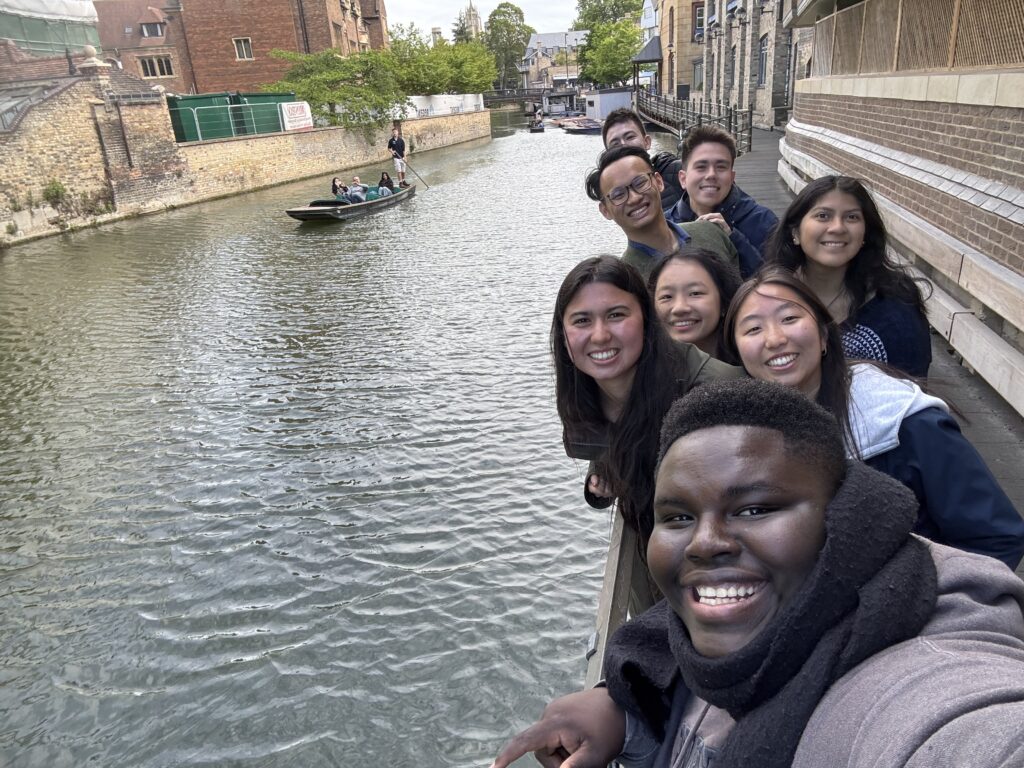
Garnet Singers by the river (look closely to see chaperones on a boat!) (photo by Nii) [A group of students standing along a walkway by the RiverCam, with boats and buildings in the background]
From Cambridge, it’s about 20 minutes on the train up to Ely, a town that was once completely surrounded by marshes. Garnet Singers would visit Ely on two separate days for a unique opportunity to sing twice at Ely Cathedral.
Ely Cathedral on its own (L) and with Garnet Singers (R) (photos by Nathan and Pat) [A photo of Ely Cathedral in the distance, behind a large, open field with tall grass and trees; a similar photo of Ely Cathedral but with four people smiling in front with their hands on their faces]
The earliest parts of Ely Cathedral date to the 7th(!) century, and the building was famously constructed using stones that residents bartered for using (what else?) the eels that lived in the surrounding marshes. It’s difficult to describe the grandeur and scale of the Cathedral, although, for context, Garnet Singers had heard from members of Selwyn College Choir that the space we would sing in was about eight times larger than the Selwyn Chapel.
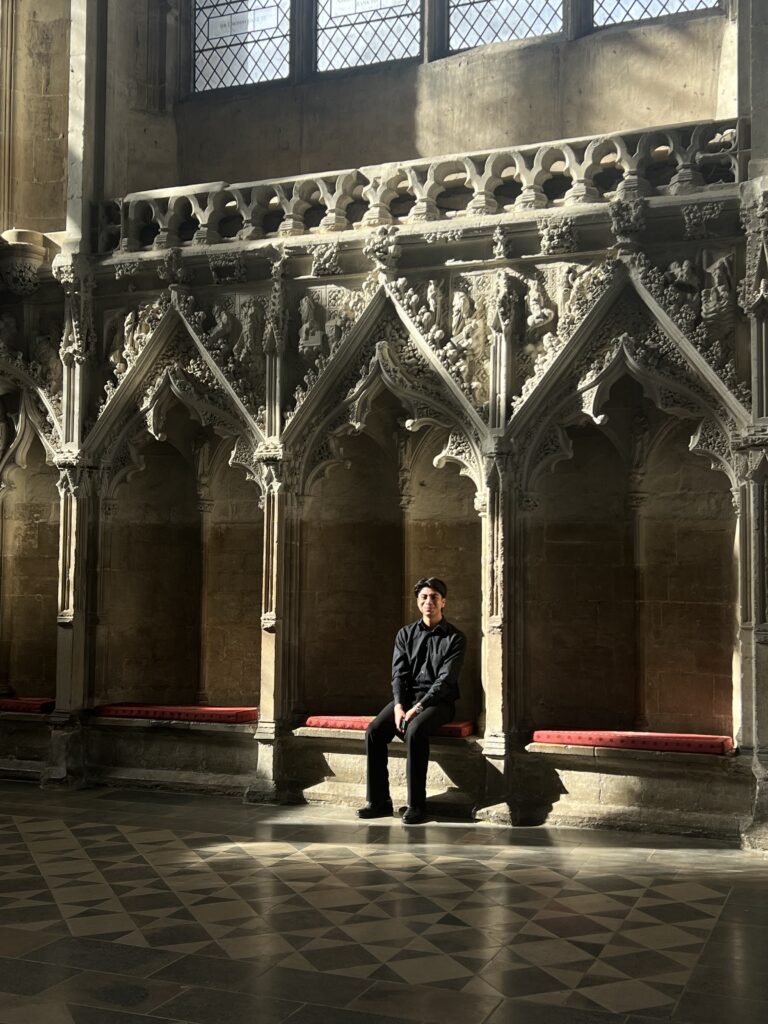
Views from inside Ely Cathedral (photos by Hsiao-Han, Nathan, and Pat) [A student sitting in a small alcove in a side chapel; detailed stonework with traces of centuries-old paint remaining; a view of the center octagon, looking up at the ceiling; Garnet Singers entering the Cathedral and looking all the way down the length of the building]
We began with a wonderful tour of the space, learning all about the history of Ely Cathedral and the surrounding town. The group then prepared for a characteristically brief rehearsal before our first singing opportunity in this gorgeous space.
The first of our visits to Ely was to sing Evensong. Fortunately, the group could repeat a large portion of the music from the previous day’s service at Selwyn. On the other hand, we would now be in a significantly larger space and, most importantly, on our own.
Garnet Singers standing in the pews in Ely Cathedral during rehearsal (photos by Hsiao-Han) [Singers standing in two rows each on either side of a central aisle, surrounding by elaborate wood carvings]
Though the material for the service had to come together quickly, all went smoothly, and it was a special treat to be able to contribute to the musical life of a space that was both so beautiful and so incredibly storied.
After several busy and exciting days in London, on May 19 Garnet Singers took a morning train to Cambridge. In just an hour’s time the busy city gave way to rolling fields and beautiful pastures.
View from the train to Cambridge (photo by Nathan) [A lush green field with a large group of sheep grazing and a wooded area in the background]
Even with the calmer scenery the group still had a busy itinerary! Silja ’28 writes about the experience of our first day in Cambridge:
While in the U.K., we had the opportunity to participate in two Evensong services, which are not as popular of a tradition in the United States. Many of us in Garnet are also less familiar with that style of sacred music, in which the choir responds to the person leading the service. This meant that aside from reviewing our music from the last two semesters, we also had to learn a whole new type of singing. Although this was definitely daunting–the musical notation and display of lyrics was also different–we had lots of help from the choral director at Jesus College in Cambridge, as well as the choir at Selwyn College. On Tuesday, we had a workshop at Jesus College and were able to learn about what might be expected of us during the service. On our last night in the U.K., we were able to observe an Evensong service at Jesus College, and see how what their director taught us translated into his work with his own choir. It was a phenomenal performance, and it was especially cool to see how there was a mix of university students and young children in the choir, all with the same attention to detail.
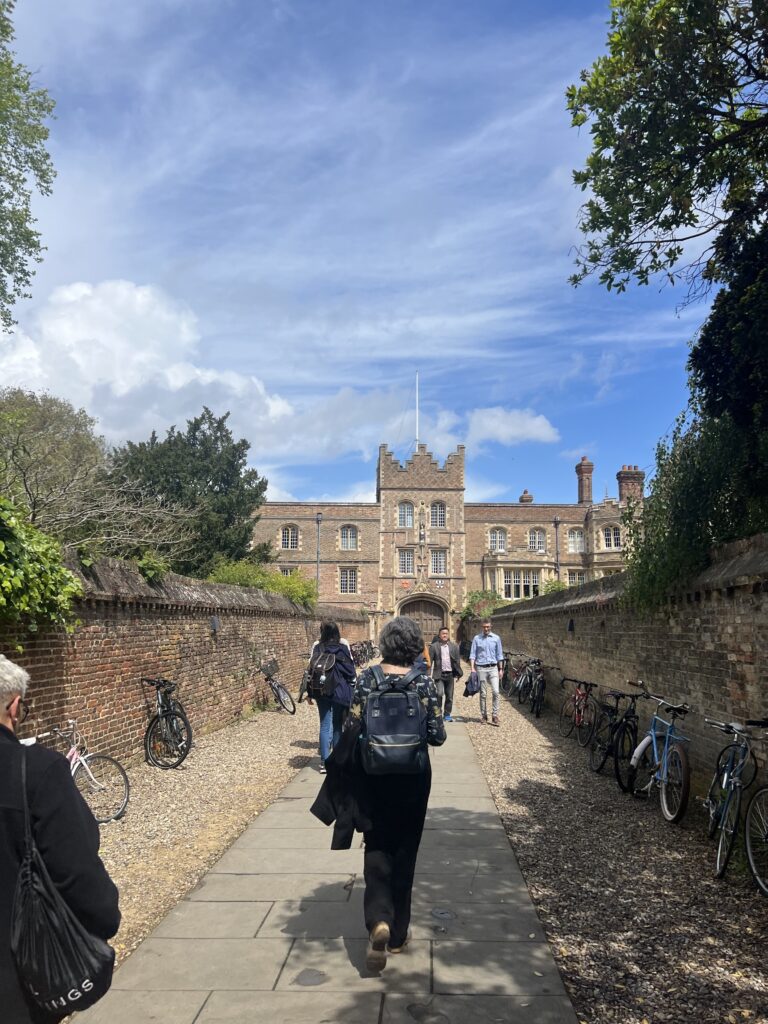
Approaching Jesus College, Cambridge (photo by Hsiao-Han) [Members of Garnet Singers walk down a walled pathway dotted with bicycles, approaching a large stone buildingin the distance]
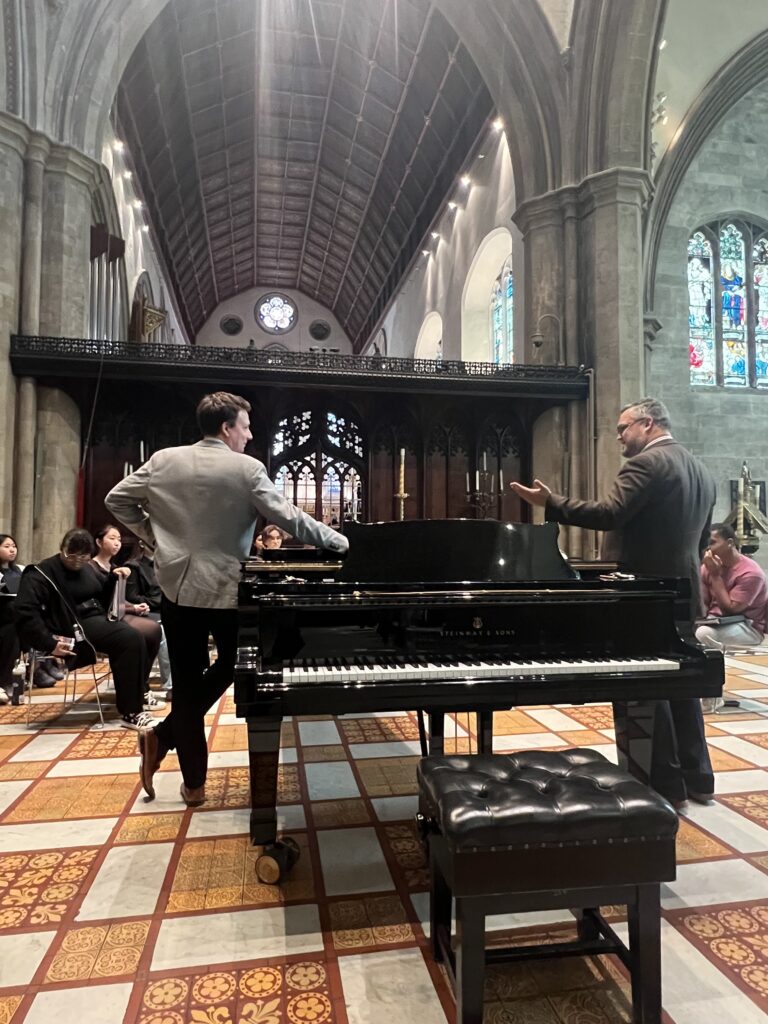
Participating in a workshop with Benjamin Sheen, Director of Music at Jesus College (photo by Hsiao-Han) [Garnet Singers sitting in a large chapel with a piano, facing directors Nathan Reiff and Benjamin Sheen, who are talking to one another]
Members of Garnet Singers in the beautiful chapel of Jesus College (dating to the 12th century!) (photo by Colette) [Four members of Garnet Singers standing in between two sets of wooden pews in an ornate chapel, with tall stained glass windows behind them]
After our workshop, we walked over to Selwyn College, where we were to sing in their own Evensong service. We participated in a fast-paced rehearsal with their director, which was especially engaging as we were practically sight-reading part of the program. Her students, however, must do this several times a week, and although they had seen this repertoire before, they often only get a brief rehearsal to learn it before the performance. This was incredibly impressive, as any musician will know, and this encouraged me to continue to improve my sight-reading skills. It was also so helpful to have the support of the other students during the service. The students standing next to me in the Selwyn choir directed me on how to stand, where to face, and the order of the music. This made our second Evensong, which we sang alone the following day at Ely Cathedral, much easier.
Colette in a courtyard at Selwyn College, Cambridge, with the chapel in the background (photo by Silja) [A person posing on a patio area in front of a large lawn with several ivy-covered brick buildings in the background; to one side is a large, ornate brick chapel]
Garnet Singers admiring Selwyn College on the way to Evensong at the chapel (photo by Nathan) [Members of Garnet Singers wearing formal attire and walking through the courtyard at Selwyn College, with brick buildings surrounding]
Aside from the unfamiliar style of sacred music, this trip also allowed me to make connections with singers from across the globe. Not only do embedded study trips help to expose us to different musical practices and give us performance opportunities, but they also foster cross-cultural communication and connections that go beyond the performances. Through participating in the Evensong service, I, alongside several others, were able to meet and spend time chatting with singers at Cambridge, which led us all to spend time together later in the trip. We spoke about music, our lives, our schools, and the different systems in the U.K. and the U.S. Alongside new choral skills, these human experiences helped to solidify this trip as an invaluable part of my education at Swarthmore, and I hope Garnet Singers continues to have opportunities like this to connect with other choral traditions and cultures.
L-R: 1) Garnet Singers sitting in the pews at Selwyn College Chapel before rehearsal; 2) Garnet Singers and the Selwyn College Choir rehearsing; 3) After the Evensong service, the choirs had more time to chat and connect before a shared dinner (photos by Hsiao-Han, Pat, and Colette) [1) Several members of Garnet Singers sitting on wooden pews in front of an intricately carved wooden wall in the chapel; 2) The combined choirs in several pews facing each other to sing, with Sarah MacDonald, Director of Music at Selwyn College, in between to lead; 3) Members of both choirs gathered in a vestibule in small groups to talk]
Michelle ’28 also writes about the experience at Selwyn College:
Swarthmore music is so tight-knit that getting to work with a different set of musicians is a pretty rare and special opportunity. Rarer yet is being invited not only to learn from them, but to perform alongside them, even in a tradition to which you are a complete novice.
The Garnet Singers were lucky enough to be invited to meet the Chapel Choir of Selwyn College at Cambridge University. I feel so grateful to have been a guest in their space—and what a space it was. England is so old, and its architecture is so incredibly beautiful! In retrospect, it’s very serendipitous that visiting another university and collaborating with its choir doubled as sightseeing for us, because what do you mean the Selwyn College chapel is the youngest at Cambridge because it was built in the 13th century? I have to admit that much of the time we spent being briefed on the nature of the services we were going to sing or the history of the college went over my head because I was too busy staring at the gorgeously painted ceiling.
I shouldn’t worry too much about being momentarily distracted, though, because our visit to Cambridge turned out to be a tremendous learning experience. Here’s the thing: as singers, we rarely practice our sight reading. Voice (in my humble opinion) is one of the easiest forms of music to learn by ear, which is an important and useful aspect of musicianship to build!
However, that musical intuition doesn’t take you very far when singing chapel music. For the uninitiated (as I was, at the beginning of this process), in the Anglican church, Evensongs are highly structured, short, frequent services that take place in the late afternoon. The choristers (that was us!) sing various settings of the same texts every time. Because there’s no variation in the words, the music tends to be quite dense and fast-paced, without a lot of repetition for your brain to hang on to. In short, sight-singing is completely essential.
I felt like I was using my instrumentalist brain far more than my vocalist brain, and even then, I had a tough time. Sight-reading as a pianist, for instance, is mostly about locating notes are on the keyboard: it’s mostly about hand-eye coordination. A singer, on the other hand, needs to hear what they see and sing what they hear: having a working knowledge of intervals is super crucial.
Just to sightsing—to parse the notes and rhythms—is hard enough, but to sight-sing well, you also need to understand how your part fits in with the others: unity of tone and musical instinct is really important in homophonic four-part choral music that’s foundational to chapel singing. And unfortunately, you don’t always get to talk out the music with a director before you perform it; sometimes you have to develop that ensemble sense as you’re hearing the music come out of your mouths.
Jesus College Choral Director Benjamin Sheen put it well when he told us singers need to not only think horizontally—about our own lines—but vertically—about the greater context of the music you’re singing. That can mean listening out for patterns: places where your part echoes others. It can mean finding where your part has a different rhythm or an unusual note and leaning into it. It can also mean listening out for the greater chord progression and making sure that your phrasing suits where you are relative to the musical resolution.
These principles are true of all music, but it was something we got to hone in on with a laser focus through chapel singing, which ended up serving as a remarkable growth opportunity for me.
Garnet Singers outside of Selwyn College Chapel after a successful Evensong service (photo by Nathan) [A large group of singers posing outside of the front entrance to the chapel, with a large and elaborate doorway behind]
After a busy day with the workshop and the flurry of the Evensong service, Garnet Singers were very fortunate to join the Selwyn College Choir at the college’s Formal Hall, a traditional sit-down dinner with students and faculty. It was a wonderful chance to relax a bit and continue to connect with new friends and we were so grateful for their generosity and time, especially in the midst of finals season! Though no photos were allowed during Formal Hall, needless to say it lived up to the Harry Potter-esque hype in every way.
Arpi ’28 writes about our experiencing observing The Bach Choir in one of their final rehearsals of J.S. Bach’s B Minor Mass:
Although this commitment was rather passive on our part, observing the Bach Choir’s rehearsal with David Hill made a very strong impression. I hadn’t known what exactly to expect, but much of the other choral singing we’d seen so far in the UK involved smaller groups, perhaps 20-30 people maximum. That’s not to say they weren’t talented or powerful; the ORA Singers, for example, packed an incredible punch with their program. However, hearing the hundreds of voices in the Bach Choir sing together was a reminder of the community significance that singing has held throughout time. There’s a tremendous musical advantage to having large groups of singers, but great numbers also create opportunities for people to connect and form influential and meaningful relationships. Music performance used to be something that was shared by everyone, whether in religious traditions or simply in people gathering around a piano and playing or singing together. Nowadays, I think it’s much rarer for people to find spontaneous or casual connection via music, which is a great loss for society.
The Bach Choir didn’t only make an impression on me because of its size. Their ways of conducting rehearsal and their skill level were also pretty unusual. Technically, having such a large number of people singing each part allows for more leeway in things like where to breathe, or what register each individual is using for a particular part because the aggregate sound can still come out solid. However, that mentality wasn’t in effect here. It was clear that there was unity and agreement within each section and among sections on what principles would be used throughout their performance, which allowed for uniform and cohesive sound. Part of that probably comes from the instincts and experiences of the singers, since this is an auditioned choir. However, I believe their overall sound and excellent is greatly shaped by their conductor/musical director David Hill. Watching him in rehearsal was like a masterclass.
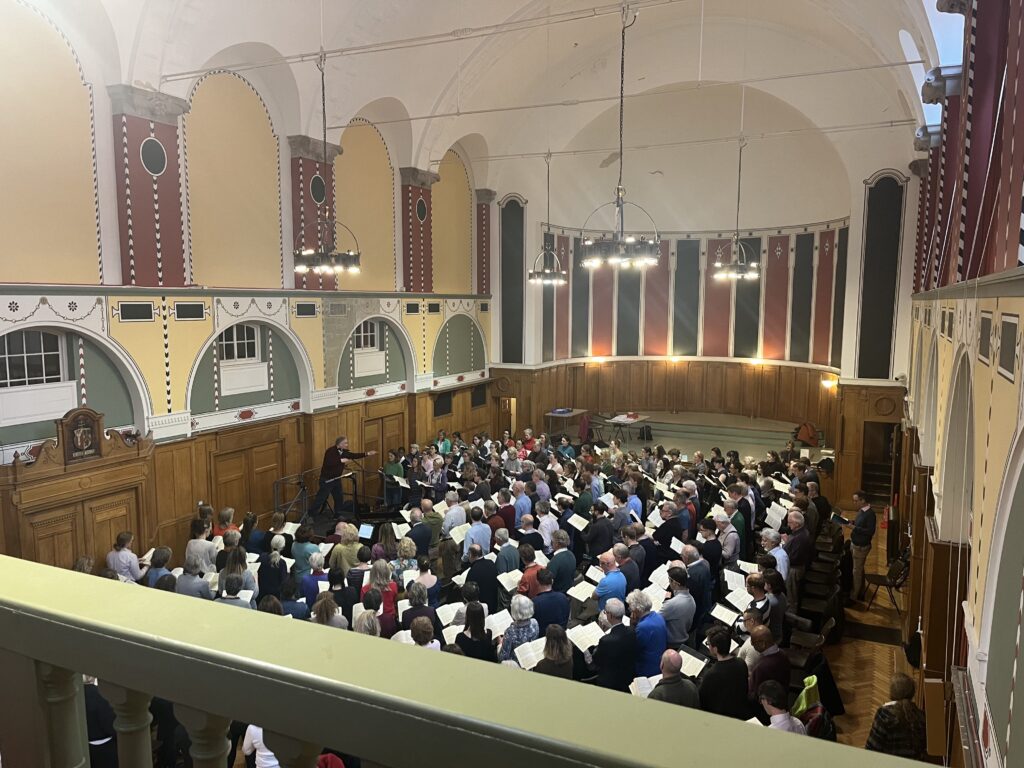
David Hill, conductor of The Bach Choir, welcomes Garnet Singers to rehearsal before they begin (photo by Pat) [A group of people sit on a balcony overlooking a large area with rows of singers seated in chairs; at the front of the balcony is a person gesturing while describing the rehearsal]
I like to practice capoeira, and one of the hallmarks of a true mestre (or master) in that sport is the absolute efficiency with which one plays. A mestre doesn’t need to play in a dramatic or flashy way, and often one might watch them and assume that their smaller steps and motions indicate a lack of ability or courage to engage with their opponent. However, such practices are truly ways to conserve energy and observe others, allowing them to move with sudden swiftness and demonstrate (or perhaps even fully throw) a move which would completely disarm their partner. This is what David Hill’s conducting put in my mind. He didn’t conduct every beat of the music. He would cue entrances and dynamic changes, sometimes seemingly just sitting on his stool without paying any attention to the choir. However, when he called them to a stop, I realized that he was using that time to listen. He caught and concentrated on small details, like the clarity of a four-measure run in the alto line or the interplay of entrances between different parts. Once he made his changes, though, I didn’t see those details as small anymore. His attentiveness brought out different themes or moods in the music which made me think, “Wow, that must be how Bach intended it to be sung in the first place.” That was my thought through most the of the rehearsal to be honest, because of the size, strength, and focus of the choir.
After watching that rehearsal, I felt a strong desire to interrogate the ways I sing in groups. Although there aren’t many groups like the Bach Choir which are both massive and high-level, that doesn’t mean that the same principles of unity of focus, attentiveness to others in both your part and others, and desire to elevate rehearsals beyond simple corrections cannot be applied elsewhere. I hope that I can bring them to bear in my own singing, and maybe even use them to improve groups I participate in.
Michelle ’28 also wrote about the experience:
In my two-ish years participating in Swarthmore’s Music Department, I’ve never run out of things to do. I take private piano lessons; I sing in vocal ensembles, both co-curricular (like Garnet) and extra-curricular (e.g. my beloved Offbeat a cappella); I compose music, sometimes with my peers; I take classes in the department, some of which, like Film Music, intersect with my own major. The list goes on. I more often find myself regretting that I can’t commit more than I already do. (Fetter, I’ve got my eye on you. One of these days, it’s gonna happen.) In my (perhaps biased) opinion, music is a juggernaut of Swarthmore’s academic offerings: we even get our own building, after all! It can especially feel that way in the context of Swarthmore’s small student body (only 1700 students).
Before I hopped on our flight to the U.K., then, I had forgotten that we are, in fact, tiny. Cozy, for sure! Intimate! But tiny.
Cut to a week later. My buddy and I got lost on our way there, but, as instructed, we eventually make our way to the Westminster Cathedral Hall, where the group rehearses. We realize we’re in the right place when we start hearing Kyrie!s with perfect clarity through the wall of solid brick.
The Bach Choir in rehearsal (photo by Nathan) [A large group of about 200 singers fit snugly into a sizable room, spaced out in many rows, and all facing the conductor, who is standing on a sizable podium]
Even now, the scale is hard to describe. We had been told that the Bach Choir was about 200 voices strong. Take a minute to think about that. That’s crazy. One class year at Swarthmore is about 400 people. Imagine doing half of First Collection, once a week, every week, for 2 hours straight. Also, they’re all in one room and they’re singing at a full fortissimo. You start to worry that your face is going to melt from the sound.
I know from experience that singing in a group that large is entirely different from what it’s like performing in a chamber choir like ours. So much of singing is about space: where you are, the air that your voice resonates through, your posture, the way you carry yourself. In a large group, your individual timbre very quickly dissolves into the larger texture. What does come through are things like phrasing, breaths, and consonants like your s’s and t’s.
The same thing applies to the space you’re singing in. The Bach Choir rehearsed in a huge, arched room that amplified sound marvelously, but has a similar tendency to blur without very careful articulation.
Getting the chance to hear a large group sing in a large room helped because we (the Garnet Singers, that is) ended up performing in some very echoey rooms without much by way of rehearsal in advance! Cathedrals, mostly, and college chapels. We also often sang with other choirs (so, in a larger group than normal) who we had often just met that day—an incredibly fun and rewarding experience! But this often meant I found myself adjusting my singing on the fly, adapting to the acoustics of the room as I was hearing it. That’s not the sort of thing I encountered when working in really familiar spaces—at Swarthmore, we have the incredible privilege of rehearsing in the same place that we perform: the Lang Music Concert Hall. Our trip was a refreshing reminder that most working musicians, amateur or professional, have to be more flexible than that!
Part of the beautiful thing about being in a choir is feeling like you’re contributing to something larger than yourself. That can be true on an intimate scale, like a chamber chorus, or as part of a grandiose musical experience. Both can be incredibly cathartic—they just require different things from the individual.
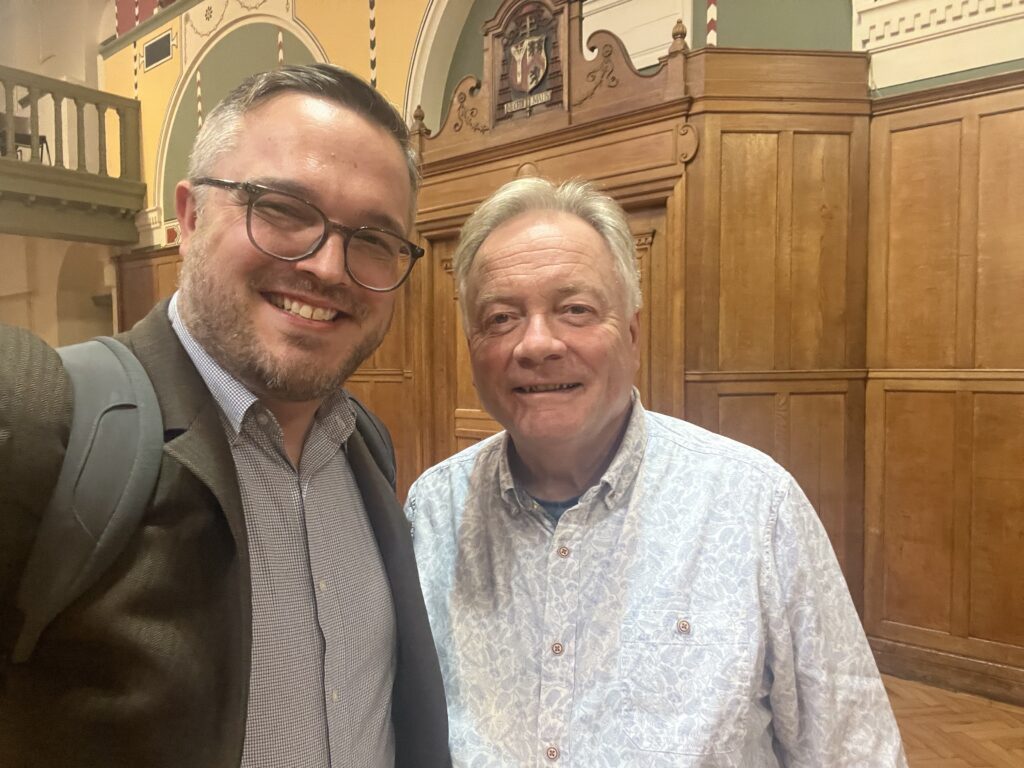
Garnet Singers conductor Nathan with his former mentor and the conductor of The Bach Choir, David Hill (photo by Nathan) [A selfie of the two conductors in the large rehearsal room The Bach Choir uses]
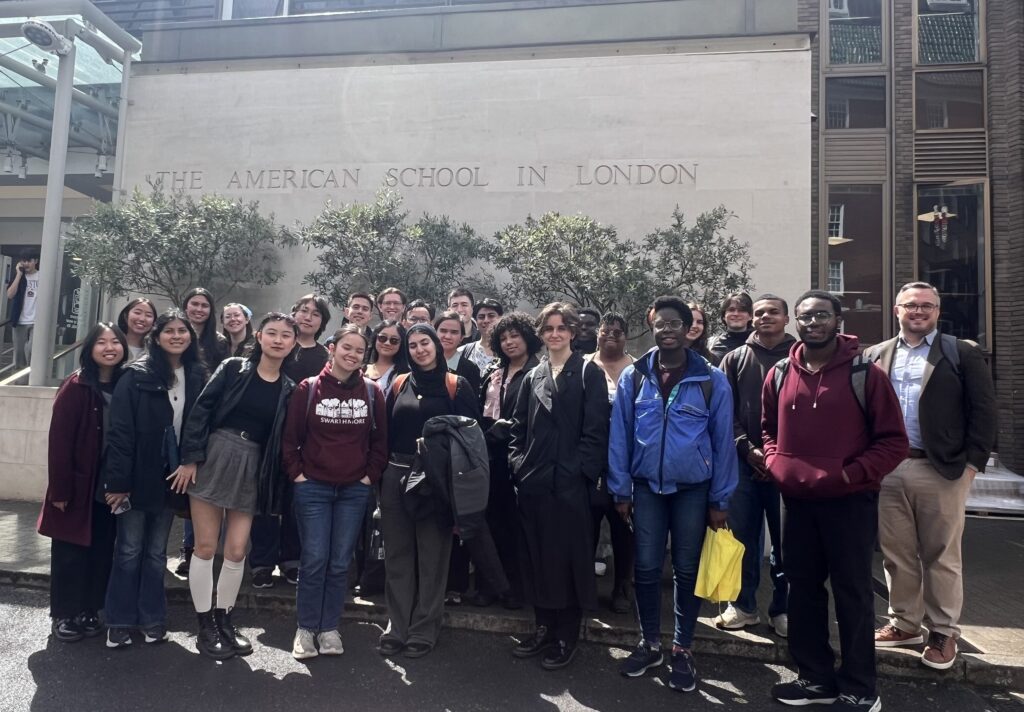
Members of Garnet Singers outside of the American School in London (photo by Hsiao-Han) [A large group of singers standing in front of a wall with an inscription reading “The American School in London”]
Lilly ’28 describes Garnet Singers’ visit to the American School in London below:
Monday, May 18th, was the day that Garnet Singers went to the American School in London for a workshop and performance. I think it is important for me to note that previous to this trip, I did not know that London had an American school. The American School in London is located in St. John’s Wood, London. I must say, it was rather jarring to hear so many American accents in England. Some of the teachers who worked at the school were American, and therefore had American accents. In turn, some of the students either adopted the American accent or were themselves American. There was one young girl with whom I spoke who had a noticeable American accent – when I asked where she was from, she said, “People ask me all the time, ‘Are you American?’ But, no, I’m from just down the street!” I was (noticeably) shocked. The girl then explained that since she’s attended ASL her entire school career, she adopted the American accent. I thought that was pretty cool!
Garnet Singers performed for and listened to several choir classes at ASL, answered questions about Swarthmore and the college experience in general, and even sang together with ASL students (photos by Hsiao-Han) [Two photos: one including members of Garnet Singers seated on the floor of a stage to answer questions from ASL students, the other with Garnet Singers standing in two rows in the middle of a performance]
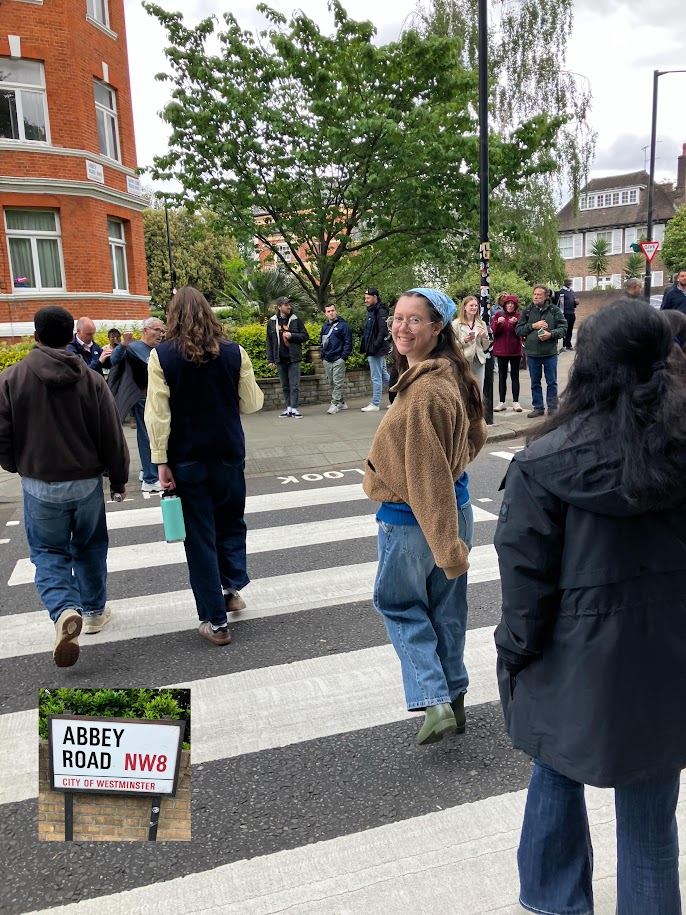
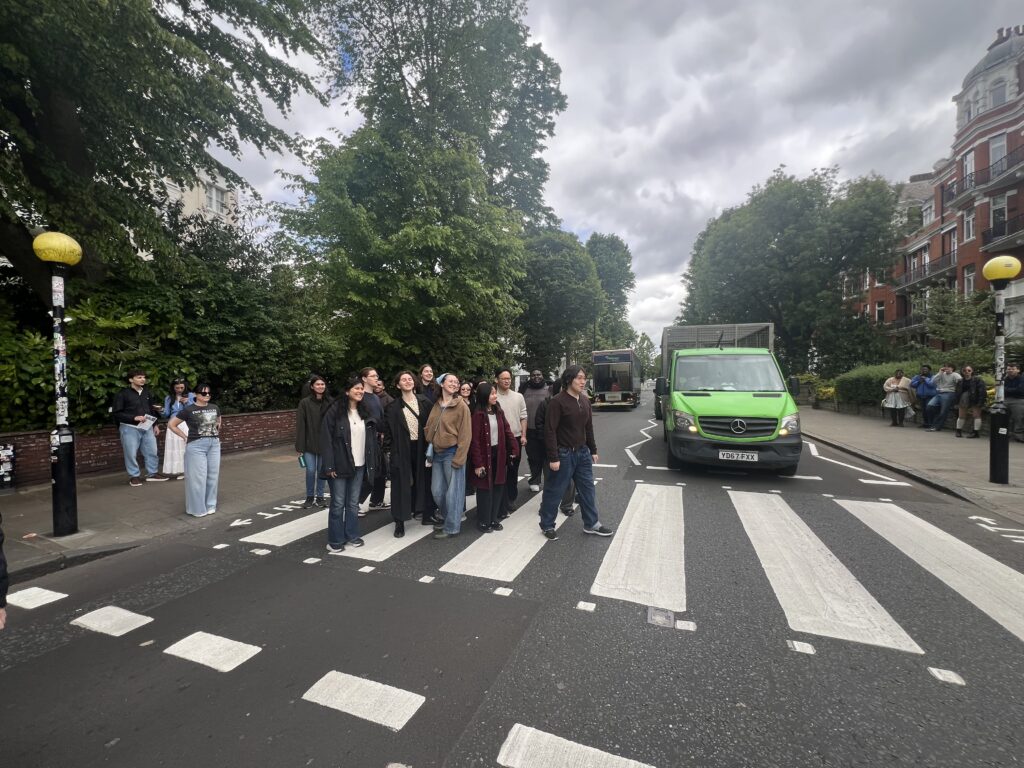
Between our three showcases and lunch, Garnet Singers had a little break. During this time, the group headed over to Abbey Road, the street the Beatles famously crossed and featured on one of their album covers. I got to walk where the Beatles were! Here is a photo from this memorable experience:
Garnet Singers at Abbey Road (photo by Lilly) [Members of Garnet Singers walking through a crosswalk at Abbey Road, famous as the location of the cover photo from the Beatles album of the same name]
Avoiding traffic at Abbey Road! (photo by Hsiao-Han) [Another photo of students posing at the Abbey Road crosswalk]
May 17 was a free morning and afternoon, and members spread out across London to take in more sights, including trips to museums, markets, libraries, restaurants, and even a service at Westminster Abbey.
London street scene (photo by Ryan) [A busy street in London with a large, ornate building in the background]
Garnet Singers and Big Ben (photo by Hannah) [A group of four students in the foreground with Big Ben and nearby buildings in the background]
St James’s Park Horse Guards Parade (photo by Colette) [A group of Garnet Singers posing in front of a fenced area with a large, open field and grand buildings behind]
A chat with some friends (photo by Silja) [Two students sitting on stools at a sculpture table surrounded by large statues of animals, also sitting on stools around the table]
After a group dinner, we gathered at St Botolph-without-Aldgate for a rehearsal before a quiet night and our last full day in London to come.
The intrepid Colette, keeper of keys! (photo by Nathan) [A person unlocking a large green door leading to our rehearsal space]
The exterior of St James’ Church Sussex Gardens (photo by Ryan) [A garden with trees in the foreground and a large church tower with ornate windows behind]
May 16 was a busy day—after the end of SingFest, we hopped on the tube with Wimbledon Choral’s conductor, Daniel Mahoney, to make our way up to St James’ Church Sussex Gardens in Paddington for a second performance. It just so happens that Daniel is also the director of the Reading Bach Choir, the choir we would collaborate with that evening. After arriving at the church, members of the RBC gave Garnet Singers a warm welcome with an afternoon tea reception before we got to the business of rehearsing and preparing for the evening’s concert.
Reading Bach Choir welcomed us with a lovely reception before our joint rehearsal (photo by Nathan) [singers standing in a church sanctuary drinking tea, eating baked goods, and chatting]
Concert poster! (poster design by Yixin ’25, photo by Nathan) [A poster with a blue and white background and a red illustration of the interior of St James’ Church and information about the joint concert, “An Evening of British and American Choral Classics]
Nii ’29 writes about our next shared concert below:
Later that day, we traveled to perform with the Reading Bach Choir at Sussex Gardens. This performance felt much closer to the type of choral setting I was more familiar with. We each performed separately and then came together to sing two combined pieces. Singing with the Reading Bach Choir gave me a deeper understanding of British choral traditions and performance practice. The members of the choir were much older than us, but they carried an incredible level of discipline, musical maturity, and attention to diction. Their articulation and pronunciation were extremely precise, and their repertoire reflected a strong connection to older sacred and classical British choral traditions. Performing alongside them made me much more aware of text clarity, phrasing, and blend within ensemble singing.
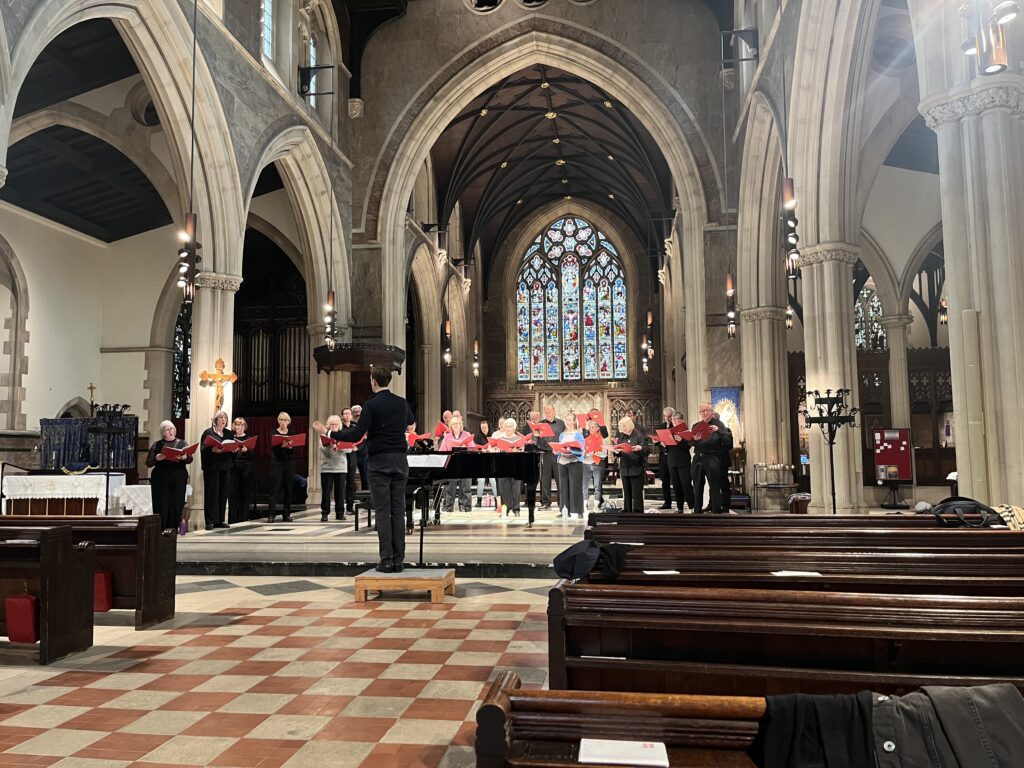
Reading Bach Choir and their director, Daniel Mahoney, rehearsing at St James’ Church (photo by Nathan) [singers of RBC wearing black and holding red folders, standing in two rows in the center of the church to rehearse in front of their director]
One of the most impactful parts of the day was how much their style of singing influenced us even after the performance ended. As a choir, we began subconsciously incorporating aspects of their musicality into our own performances, especially in terms of articulation, tone, and intentionality with text. This experience taught me that choral music is not just about singing notes correctly, but about carrying history, culture, and tradition through sound. British choral music, especially in the sacred tradition, values clarity, blend, discipline, and emotional restraint in a way that differs from some American choral styles I have experienced. Understanding that history changed the way I approached singing throughout the trip because I became more intentional about diction, breath control, and listening carefully within the ensemble.
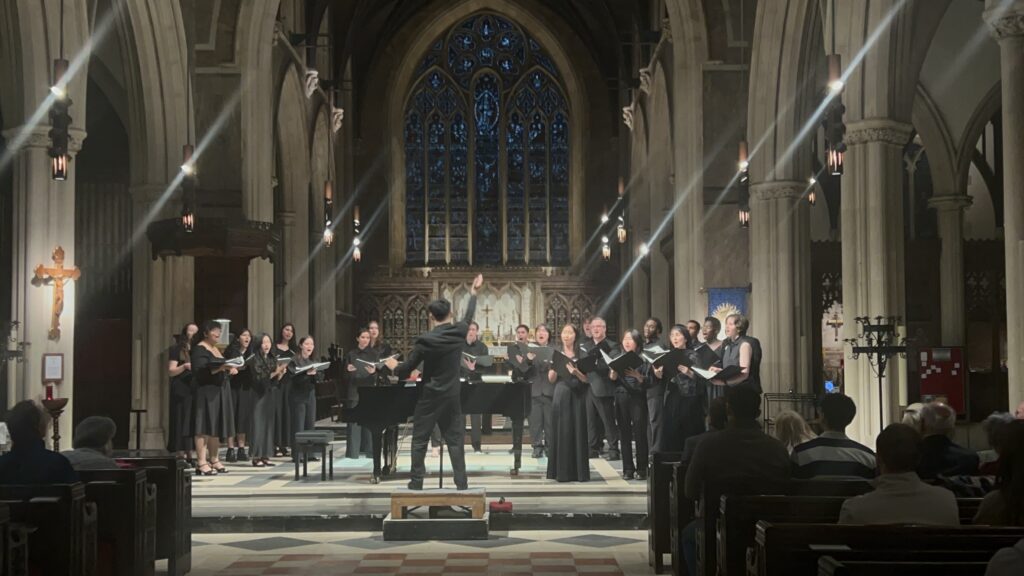
Garnet Singers performing “Didn’t My Lord Deliver Daniel,” arranged by Moses Hogan and led by student conductor Julian ’28, featuring a small solo group (photo by Hsiao-Han) [members of Garnet Singers standing in two rows in the center of the church to sing during the performance; four singers in a small group in front and the conductor, Julian, gesturing with one arm raised]
Overall, this day reminded me that being a choral musician is not only about individual talent, but about community, adaptability, and shared expression. If I could share one lesson with future Garnet Singers, it would be that the most meaningful musical experiences often happen when perfection becomes less important than connection.
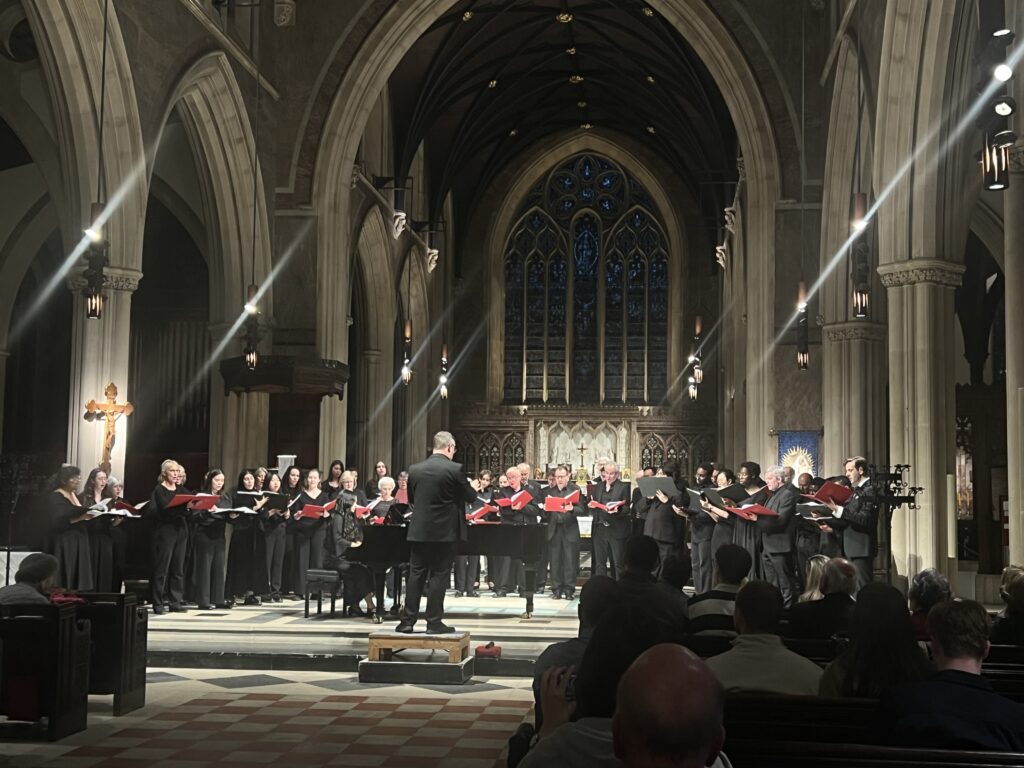
Garnet Singers and RBC performing “Hold On” by Margaret Bonds and featuring student pianist Chung Sze ’27 (photo by Hsiao-Han) [members of both choirs—some holding black folders, some holding red—standing in a large group around the piano to sing in the concert]
Post-concert group pic! (photo by Pat) [members of Garnet Singers standing in two rows around the piano for a group picture after the performance]
Garnet Singers were thrilled that several Swarthmore alumni were in the audience for the Sussex Gardens concert, and after the performance we gathered at a nearby pub for a reception coordinated by the Advancement office and Gehan Talwatte ’87. It was a lovely way to connect with members of the Swat community so far away from campus, and members of Garnet Singers even took up an invitation to perform a bit for the other patrons!
Celebrating with Swarthmore alumni at the post-concert reception (photos and video by Colette) [students and alumni standing and seated at a restaurant, chatting and smiling, and performing an excerpt of Cells Planets by Lloyd/Peterson]